产品详情
-
产品名称
重组人BLTP2蛋白
-
蛋白种属
人
-
表达宿主
大肠杆菌
- Unitprot ID
-
蛋白序列
MNHKVHHHHHHGGSVDTFTLIHHELEISTNPAQYAMILDIVNNLLLHVEPKRKEHSEKKQRVRFQLEISSNPEEQRSSILHLQEAVRQHVAQIRQLEKQMYSIMKSLQDDSKNENLLDLNQKLQLQLNQEKANLQLESEELNILIRCFKDFQLQRANKMELRKQQEDVSVVRRTEFYFAQARWRLTEEDGQLGIAELELQRFLYSKVNKSDDTAEHLLELGWFTMNNLLPNAVYKVVLRPQSSCQSGRQLALRLFSKVRPPVGGISVKEHFEVNVVPLTIQLTHQFFHRMMGFF
-
克隆构建
DNA encoding 1750-2029 aa (Q14667) were fused with N-terminal 6His tag.
-
蛋白纯度
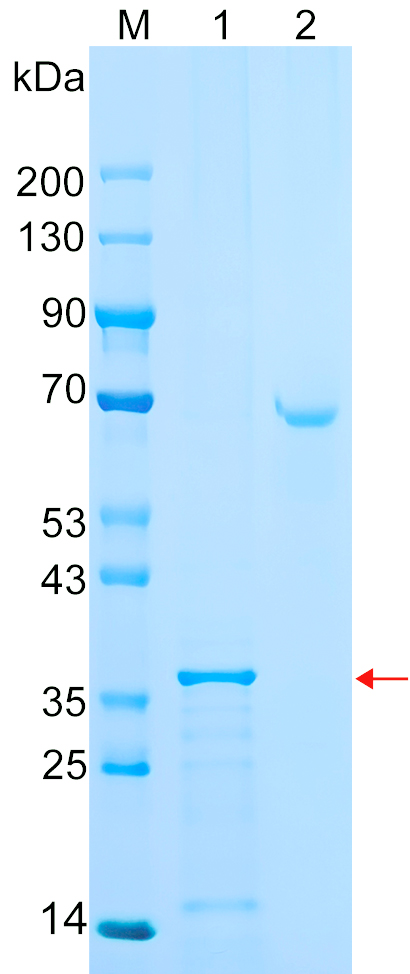
>85%, by SDS-PAGE with Coomassie Brilliant Blue staining.
-
蛋白活性
Not tested.
-
分子量
Predictes a molecular mass of 34.64 kDa. In SDS-PAGE under reducing conditions, it migrates as an approximately 35 kDa band.
-
蛋白全名
Bridge-like lipid transfer protein family member 2
-
蛋白描述
Recombinant human Bridge-like lipid transfer protein family member 2 (BLTP2) fragment (residues 1750-2029) is a high-quality protein product designed for structural and biochemical studies. This 280-amino acid fragment, computationally selected for stability and solubility, enables researchers to investigate the lipid transport functions of BLTP2 in a manageable and functional format.
Bridge-like lipid transfer protein family member 2 (BLTP2) is a tube-forming lipid transport protein that specifically binds to phosphatidylinositols and modulates the distribution of phosphatidylinositol-4,5-bisphosphate (PtdIns-4,5-P2), playing a crucial role in cellular lipid homeostasis. The protein localizes to multiple membrane compartments, including the cell membrane, endoplasmic reticulum membrane, and mitochondrial membrane, where it facilitates lipid transfer at membrane contact sites such as endoplasmic reticulum-cell membrane and endoplasmic reticulum-mitochondria interfaces. This strategic localization underscores its importance in inter-organelle lipid trafficking and membrane dynamics.
-
检测结果
Recombinant BLTP2 protein (His tag) SDS-PAGE
M: Marker; Lane 1: BLTP2; Lane 2: BSA
-
发货形式
Lyophilized from sterile PBS, pH 7.4
-
内毒素
Please contact the lab for more information.
-
保存条件
Store it under sterile conditions at -20℃ to -80℃. It is recommended that the protein be aliquoted for optimal storage. Avoid repeated freeze-thaw cycles.