产品详情
-
产品名称
重组人KIF2C蛋白
-
蛋白种属
人
-
表达宿主
大肠杆菌
- Unitprot ID
-
蛋白序列
MNHKVHHHHHHGGSSCLVKEVEKMKNKREEKKAQNSEMRMKRAQEYDSSFPNWEFARMIKEFRATLECHPLTMTDPIEEHRICVCVRKRPLNKQELAKKEIDVISIPSKCLLLVHEPKLKVDLTKYLENQAFCFDFAFDETASNEVVYRFTARPLVQTIFEGGKATCFAYGQTGSGKTHTMGGDLSGKAQNASKGIYAMASRDVFLLKNQPCYRKLGLEVYVTFFEIYNGKLFDLLNKKAKLRVLEDGKQQVQVVGLQEHLVNSADDVIKMIDMGSACRTSGQTFANSNSSRSHACFQIILRAKGRMHGKFSLVDLAGNERGADTSSADRQTRMEGAEINKSLLALKECIRALGQNKAHTPFRESKLTQVLRDSFIGENSRTCMIATISPGISSCEYTLNTLRYADRVKE
-
克隆构建
DNA encoding 192-587 aa (Q99661) were fused with N-terminal 6His tag.
-
蛋白纯度
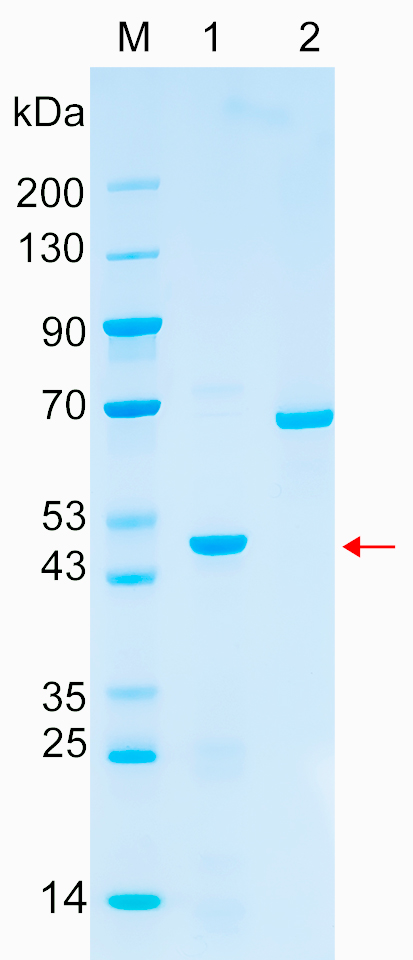
>90%, by SDS-PAGE with Coomassie Brilliant Blue staining.
-
蛋白活性
Not tested.
-
分子量
Predictes a molecular mass of 46.36 kDa. In SDS-PAGE under reducing conditions, it migrates as an approximately 47 kDa band.
-
蛋白全名
Kinesin-like protein KIF2C
-
蛋白描述
Recombinant KIF2C (192-587) is a high-quality protein fragment derived from human Kinesin-like protein KIF2C, designed for structural and biochemical studies. This stable and soluble unit retains functional relevance, offering researchers a reliable tool to investigate microtubule dynamics and mitotic regulation.
KIF2C, also known as Mitotic Centromere-Associated Kinesin (MCAK), plays a critical role in chromosome segregation during mitosis. In complex with KIF18B, it constitutes the major microtubule plus-end depolymerizing activity in mitotic cells, regulating microtubule turnover at the kinetochore and facilitating the lateral to end-on conversion of chromosome-microtubule attachments. The protein localizes to the cytoplasm, cytoskeleton, nucleus, centromere, and kinetochore, associating with microtubule plus ends through interactions with partners like KIF18B, MTUS2/TIP150, and MAPRE1. Its centromeric localization depends on BUB1 and SGO2, underscoring its importance in ensuring accurate chromosome congression and mitotic fidelity.
-
检测结果
Recombinant KIF2C protein (His tag) SDS-PAGE
M: Marker; Lane 1: KIF2C; Lane 2: BSA.
-
发货形式
Lyophilized from sterile PBS, pH 7.4
-
内毒素
Please contact the lab for more information.
-
保存条件
Store it under sterile conditions at -20℃ to -80℃. It is recommended that the protein be aliquoted for optimal storage. Avoid repeated freeze-thaw cycles.