产品详情
-
产品名称
重组人NR1H3蛋白
-
蛋白种属
人
-
表达宿主
大肠杆菌
- Unitprot ID
-
蛋白序列
MNHKVLGNELCSVCGDKASGFHYNVLSCEGCKGFFRRSVIKGAHYICHSGGHCPMDTYMRRKCQECRLRKCRQAGMREECVLSEEQIRLKKLKRQEEEQAHATSLPPRASSPPQILPQLSPEQLGMIEKLVAAQQQCNRRSFSDRLRVTPWPMAPDPHSREARQQRFAHFTELAIVSVQEIVDFAKQLPGFLQLSREDQIALLKTSAIEVMLLETSRRYNPGSESITFLKDFSYNREDFAKAGLQVEFINPIFEFSRAMNELQLNDAEFALLIAISIFSADRPNVQDQLQVERLQHTYVEALHAYVSIHHPHDRLMFPRMLMKLVSLRTLSSVHSEQVFALRLQDKKLPPLLSEIWDVHELEHHHHHH
-
克隆构建
DNA encoding 93-447 aa (Q13133) were fused with C-terminal 6His tag.
-
蛋白纯度
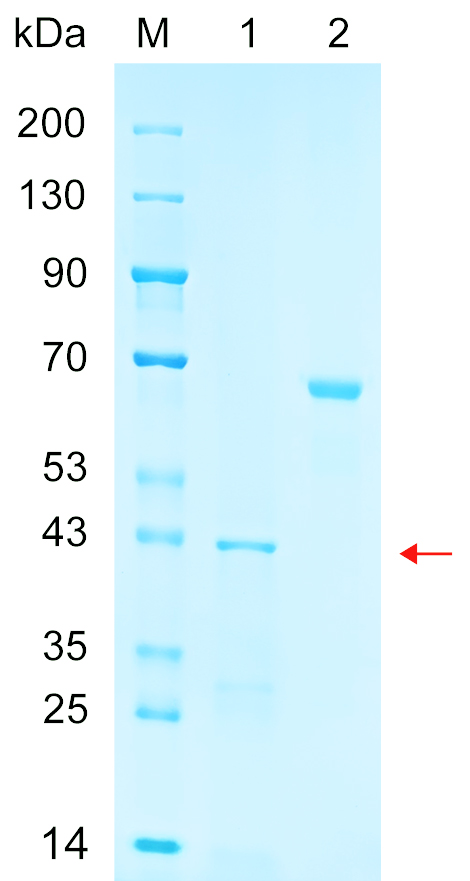
>85%, by SDS-PAGE with Coomassie Brilliant Blue staining.
-
蛋白活性
Not tested.
-
分子量
Predictes a molecular mass of 42.51 kDa. In SDS-PAGE under reducing conditions, it migrates as an approximately 43 kDa band.
-
蛋白全名
Oxysterols receptor LXR-alpha
-
蛋白描述
Recombinant Human LXR-alpha (NR1H3) Fragment (residues 93-447) is a high-purity protein product encompassing the full nuclear receptor ligand-binding domain (LBD). This fragment serves as an essential tool for investigating ligand-dependent transcriptional regulation, cholesterol homeostasis, and lipid metabolism pathways in a domain-specific context.
Liver X receptor alpha (LXR-alpha), encoded by the NR1H3 gene, functions as a nuclear receptor with ligand-dependent transcriptional activation activity. It plays a critical role in cholesterol homeostasis by regulating cholesterol uptake through MYLIP-dependent ubiquitination of LDLR, VLDLR and LRP8. LXR-alpha interacts with retinoic acid receptor (RXR) to mediate retinoid responses through DR4-type LXRES response elements. Additionally, it regulates phospholipid remodeling in endoplasmic reticulum membranes via LPCAT3, driving SREBF1 processing and lipogenesis while modulating membrane dynamics for VLDL particle assembly. The receptor localizes to bot
-
检测结果
Recombinant NR1H3 protein (His tag) SDS-PAGE
M: Marker; Lane 1: NR1H3; Lane 2: BSA
-
发货形式
Lyophilized from sterile PBS, pH 7.4
-
内毒素
Please contact the lab for more information.
-
保存条件
Store it under sterile conditions at -20℃ to -80℃. It is recommended that the protein be aliquoted for optimal storage. Avoid repeated freeze-thaw cycles.