产品详情
-
产品名称
重组人SFPQ蛋白
-
蛋白种属
人
-
表达宿主
大肠杆菌
- Unitprot ID
-
蛋白序列
MSKIKLLRRPGEKTYTQRCRLFVGNLPADITEDEFKRLFAKYGEPGEVFINKGKGFGFIKLESRALAEIAKAELDDTPMRGRQLRVRFATHAAALSVRNLSPYVSNELLEEAFSQFGPIERAVVIVDDRGRSTGKGIVEFASKPAARKAFERCSEGVFLLTTTPRPVIVEPLEQLDDEDGLPEKLAQKNPMYQKERETPPRFAQHGTFEYEYSQRWKSLDEMEKQQREQVEKNMKDAKDKLESEMEDAYHEHQANLLRQDLMRRQEELRRMEELHNQEMQKRKEMQLRQEEERRRREEEMMIRQREMEEQMRRQLEHHHHHH
-
克隆构建
DNA encoding 284-592 aa (P23246) were fused with C-terminal 6His tag.
-
蛋白纯度
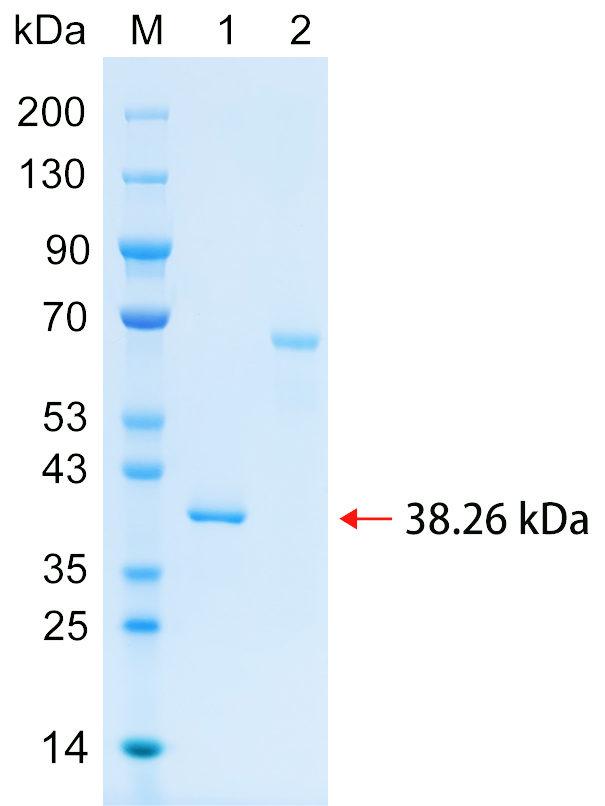
>86%, by SDS-PAGE with Coomassie Brilliant Blue staining.
-
蛋白活性
Not tested.
-
分子量
Predictes a molecular mass of 38.26 kDa. In SDS-PAGE under reducing conditions, it migrates as an approximately 45 kDa band.
-
蛋白全名
Splicing factor, proline- and glutamine-rich
-
蛋白描述
Recombinant Human SFPQ Fragment (aa 284-592): A high-purity, functional protein fragment encompassing the essential RRM 1 and RRM 2 domains of Splicing Factor, Proline- and Glutamine-Rich (SFPQ/PSF). This product is an ideal tool for studying RNA binding, spliceosome assembly, and transcriptional regulation in a defined, domain-specific context.
SFPQ is a multifunctional nuclear protein involved in critical cellular processes including pre-mRNA splicing, transcriptional regulation, and DNA repair. As a DNA- and RNA-binding protein, it functions as an essential splicing factor required early in spliceosome formation and for the catalytic step of splicing, typically as a heteromer with NONO. The protein specifically binds intronic polypyrimidine tracts and regulates signal-induced alternative splicing. Beyond splicing, SFPQ participates in transcriptional activation and repression, circadian clock regulation, DNA unwinding, and double-strand break repair through non-homologous end joining. It localizes predominantly to nuclear speckles and the nuclear matrix, with some cytoplasmic presence. The provided fragment contains the core RNA recognition motifs (RRM 1 and RRM 2) that mediate nucleic acid binding interactions central to SFPQ's diverse molecular functions.
-
检测结果
Recombinant SFPQ protein (His tag) SDS-PAGE
M: Marker; Lane 1: SFPQ; Lane 2: BSA
-
发货形式
Lyophilized from sterile 25 mM HEPES, 20 mM NaCl, pH 8.0
-
内毒素
Please contact the lab for more information.
-
保存条件
Store it under sterile conditions at -20℃ to -80℃. It is recommended that the protein be aliquoted for optimal storage. Avoid repeated freeze-thaw cycles.