产品详情
-
产品名称
重组人SYT7蛋白
-
蛋白种属
人
-
表达宿主
大肠杆菌
- Unitprot ID
-
蛋白序列
MNHKVNLGRIQFSVGYNFQESTLTVKIMKAQELPAKDFSGTSDPFVKIYLLPDKKHKLETKVKRKNLNPHWNETFLFEGFPYEKVVQRILYLQVLDYDRFSRNDPIGEVSIPLNKVDLTQMQTFWKDLKPCSDGSGSRGELLLSLCYNPSANSIIVNIIKARNLKAMDIGGTSDPYVKVWLMYKDKRVEKKKTVTMKRNLNPIFNESFAFDIPTEKLRETTIIITVMDKDKLSRNDVIGKIYLSWKSGPGEVKHWKDMIARPRQPVAQWHQLKALEHHHHHH
-
克隆构建
DNA encoding 135-403 aa (O43581) were fused with C-terminal 6His tag.
-
蛋白纯度
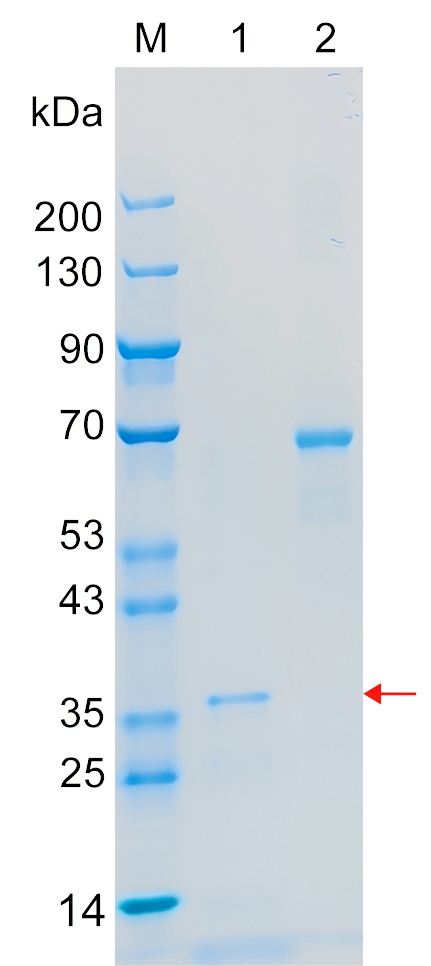
>85%, by SDS-PAGE with Coomassie Brilliant Blue staining.
-
蛋白活性
Not tested.
-
分子量
Predictes a molecular mass of 32.83 kDa. In SDS-PAGE under reducing conditions, it migrates as an approximately 35 kDa band.
-
蛋白全名
Synaptotagmin-7
-
蛋白描述
Recombinant Human Synaptotagmin-7 (SYT7) Fragment (aa 135-403) is a high-purity protein encompassing both C2 domains (C2-1 and C2-2), essential for calcium and phospholipid binding. This fragment serves as an ideal tool for investigating Ca²⁺-dependent exocytosis, membrane fusion mechanisms, and synaptic facilitation in neurological and secretory research applications.
Synaptotagmin-7 (SYT7) is a high-affinity calcium sensor that plays a critical role in Ca²⁺-triggered exocytosis of synaptic vesicles, lysosomes, and secretory granules. It regulates key processes including synaptic facilitation, plasma membrane repair, phagocytosis, bone remodeling, and hormone secretion by binding to phospholipid membranes and SNARE complexes via its C2 domains. The protein localizes to multiple membranes including the presynaptic membrane, synaptic vesicles, lysosomes, phagosomes, and peroxisomes, with its lysosomal targeting dependent on N-terminal palmitoylation and CD63 interaction. Its involvement in Trypanosoma cruzi cell invasion and cholesterol transport between organelles further highlights its multifunctional significance in cellular physiology.
-
检测结果
Recombinant SYT7 protein (His tag) SDS-PAGE
M: Marker; Lane 1: SYT7; Lane 2: BSA
-
发货形式
Lyophilized from sterile PBS, pH 7.4
-
内毒素
Please contact the lab for more information.
-
保存条件
Store it under sterile conditions at -20℃ to -80℃. It is recommended that the protein be aliquoted for optimal storage. Avoid repeated freeze-thaw cycles.